Showing posts with label 2015. Show all posts

Friday, December 1, 2023

009. Madhubani Painting

Madhubani painting is a style of painting named after the Madhubani district of Bihar, India, which is where it originated. Artists create these paintings using a variety of mediums, including their own fingers, or twigs, brushes, nib-pens, and matchsticks. The paint is created using natural dyes and pigments. The paintings are characterised by their eye-catching geometrical patterns. 

According to legend, Madhubani paintings were first created at Mithila, the birthplace of Hindu goddess Sita. When Sita and her husband Prince Rama were to be married, King Janak, father to Sita, asked for paintings to capture moments of the marriage. 

Madhubani painting was traditionally created by the women, the painting was done on freshly plastered mud walls and floors of huts; but over the years it has moved to varied mediums including cloths, handmade papers, and canvas. There is ritual content for particular occasions, such as birth or marriage, and festivals, such as Holi, Surya Shasti, Kali Puja, Upanayana, and Durga Puja. 
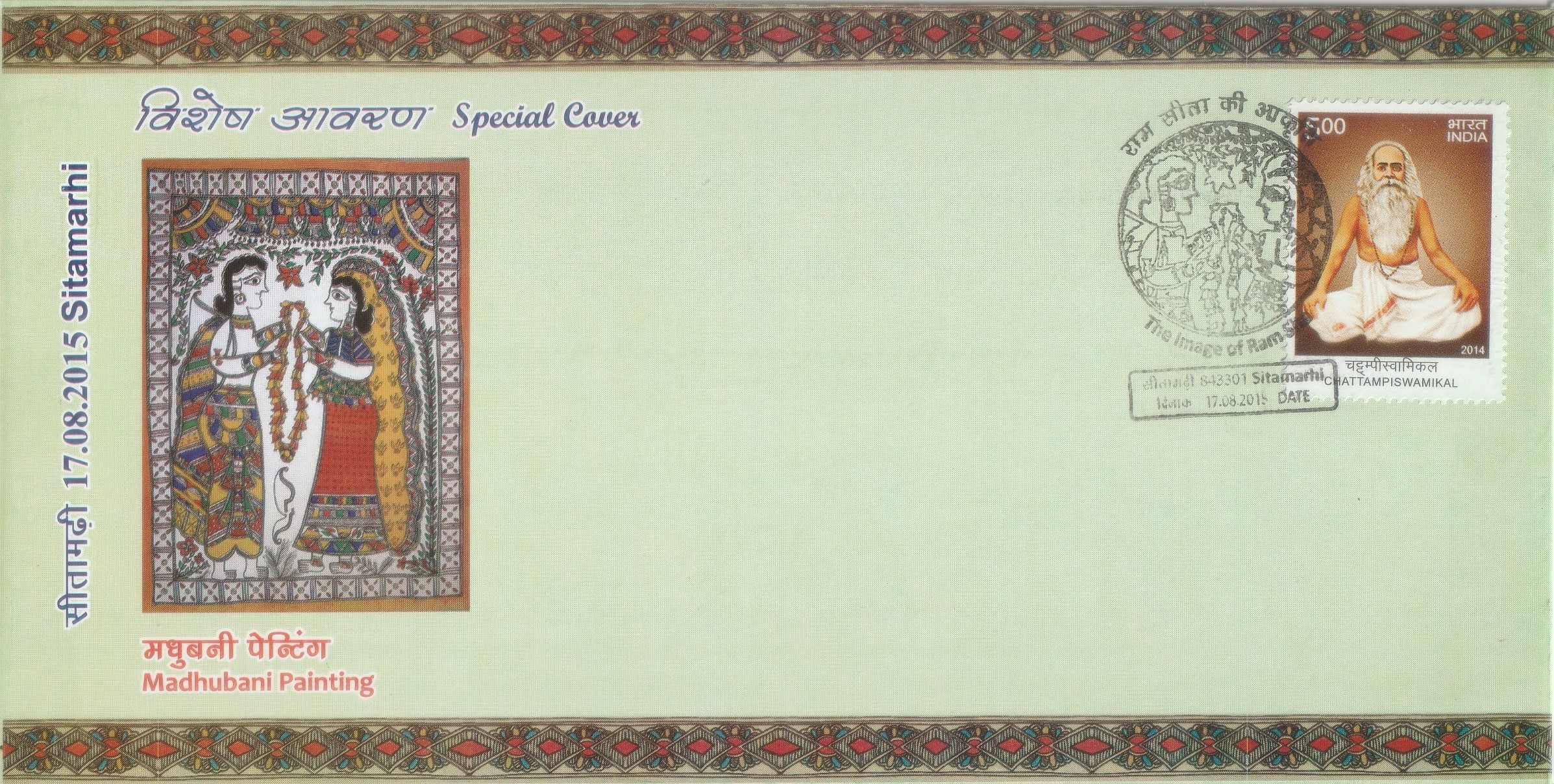

GI Tag Registration Date         : 16 May 2007

GI Tag Number                         : 37

Certificate Number                  : 31

Geographical Area                  : Bihar

Special Cover Release Date   : 17 August 2015

Cancellation                             : Sitamarhi 843 301

Type                                          :  Special Cover

Cover Identification Number  :  BH/08/Aug/2015

Enlarged View of Illustration

Enlarged View of Cancellation

Images of stamps issued by India Post relevant to Madhubani Painting is furnished below

Stamp on Madhubani Painting depicting Krishna with Gopies 
Issued on 15 October 2000

Stamp on Madhubani Painting depicting Flower with Girls
Issued on 15 October 2000

Stamp on Madhubani Painting depicting Bali & Sugriva 
Issued on 15 October 2000

Setenant Pair on Madhubani Painting depicting Geometrical Pattern 
Issued on 15 October 2000

Wednesday, November 29, 2023

006. Puneri Pagadi

The Puneri Pagadi is a distinctive style of turban, which is considered as a symbol of pride and honour in the city of Pune. It was introduced in the 19th century by Mahadev Govind Ranade, a social reformer. Later, it was worn by many leaders, including Lokmanya Tilak. 

Though it is a symbol of honour, the pagadi is mostly worn for special occasions like wedding ceremonies and traditional days in schools and colleges. Youngsters wear it while performing the Gondhal art form.

The primary fabric is either cotton or silk. It is further mixed with starch obtained from various homemade processes. The purpose of adding starch is to give the royal headband the permanent folds it needs. It holds the most beautiful curves in place.


GI Tag Registration Date         : 04 September 2009

GI Tag Number                         : 128

Certificate Number                  : 109

Geographical Area                  : Maharashtra

Special Cover Release Date   : 10 December 2015

Cancellation                             : Pune 411 004

Type                                          :  Special Cover

Cover Identification Number  :  MH/38/2015

This cover has a small replica of Puneri Pagadi and covers are numbered.

Enlarged View of Illustration

Enlarged View of Cancellation

Image of the Stamp issued by India Post related to Puneri Pagadi is furnished below

Stamp extracted from Headgears of India Mixed Sheetlet
Issued on 10 February 2017

Sunday, November 26, 2023

005. Thanjavur Veenai

Thanjavur Veenai is a handicraft product originating from Tamil Nadu and is one of the most ancient and revered Indian musical instruments. Thanjavur Veena is the first musical instrument in the country to get the GI tag.

The work involves making the resonator (kudam), the neck (dandi) and a tuning box, the three integral parts of the Veena. Jackfruit wood is used to make the Veena. The wood gets cut, intricately carved, shaped, and assembled. The body of the Veena is beautifully painted, carved and chiselled by hand. This makes the Thanjavur Veena distinct and elegant from other Veenas. 

In the case of 'Ottu' veena, the parts are made separately and assembled. In the case of 'Ekantha' veena, it gets carved out of the whole wood of the jackfruit tree.

The Thanjavur Veena has four playing cords/strings. And, there are three special thalam strings. The major bridge that produces all important notes is a flat bar. The flat bar is made of exquisite brass. The bar is not straight; however, you will see a slight curve on its surface and this gives the Thanjavur Veena its unique, characteristic sound.


GI Tag Registration Date         : 30 March 2013

GI Tag Number                         : 209

Certificate Number                  : 188

Geographical Area                  : Tamil Nadu

Special Cover Release Date   : 03 September 2015

Cancellation                             : Thanjavur 613 001

Type                                          :  Special Cover

Cover Identification Number  :  TN/24/2015

Enlarged View of Illustration

Enlarged View of Cancellation


004. Thanjavur Doll

The Thanjavur doll is a type of traditional Indian bobblehead or roly-poly toy made of terracotta material and is a part of Thanjavur's traditional arts. 

The centre of gravity and total weight of the doll is concentrated at its bottom-most point, generating a dance-like continuous movement with slow oscillations. It is quite interesting to note how the doll's centre of gravity was identified and used during the early days.  

The round bottomed toy comes in sitting, standing and rotating types. These toys are traditionally handmade, finished with detailed, painted exteriors. The doll is mostly made of wood, white stone powder, tapioca and paper. There are two versions of the doll – the tilting version and the bobble head version. Generally, these creations are sold in pairs, where you will find a queen and king.

The upper part of the doll is hollow whereas the bottom of the doll is structured such that it is heavy, curved (with a hemispherical base), and also designed in such a way that it will not topple over when external force is applied: it oscillates slowly and comes back to a stable position. These oscillations generate a dance-like appearance in the dolls, with slow oscillations and the center of gravity working with the total weight of the doll for it to move beautifully. 


GI Tag Registration Date         : 09 September 2008

GI Tag Number                         : 96

Certificate Number                  : 89

Geographical Area                  : Tamil Nadu

Special Cover Release Date   : 03 September 2015

Cancellation                             : Thanjavur 613 001

Type                                          :  Special Cover

Cover Identification Number  :  TN/26/2015

Enlarged View of Illustration

Enlarged View of Cancellation

Image of Postage Stamp issued by India Post is furnished below, where in the Thanjavur doll is depicted on the left

Postage Stamp Issued on 14 November 2010

Saturday, November 25, 2023

003. Thanjavur Art Plate

The Thanjavur Art Plate is an artifact which is exclusively made in Thanjavur, Tamil Nadu, India. It is a circular plate and a handicraft consisting of metals such as silver, bronze, and copper embossed with figures of gods and goddesses at its center. 

The Thanjavur Art Plate was made as an exclusive gift item by the artisans of Thanjavur at the suggestion of the Rajah Serfoji-II (1777–1832) during the Maratha rule in Thanjavur. However, today, the usage of these art plates has expanded to a multitude of purposes. 

With symbols of deities, animals, and saints inscribed in the centre and intricate floral designs and geometric patterns carved out at the peripheries, these art plates are emblems of the ancient Indian tradition and how this tradition finds its place in the contemporary world. 


GI Tag Registration Date         : 24 September 2007

GI Tag Number                         : 63

Certificate Number                  : 42

Geographical Area                  : Tamil Nadu

Special Cover Release Date   : 03 September 2015

Cancellation                             : Thanjavur 613 001

Type                                          :  Special Cover

Cover Identification Number  :  TN/27/2015

Enlarged View of Illustration

Enlarged View of Cancellation


Friday, November 24, 2023

002. Thanjavur Paintings

A classical artform from southern India, Thanjavur painting is a celebration of the region’s rich artistic tradition, named after the town of Thanjavur in Tamil Nadu, India. 

Thanjavur paintings are known for their extravagant depictions of deities using vibrant colours and gaudy embellishments, especially gold foil overlaid on delicate but extensive gesso work and inlay of glass beads and pieces or very rarely precious and semi-precious gems . 

In Thanjavur paintings one can see the influence of Deccani, Vijayanagara, Maratha and even European or Company styles of painting. Though the artform has undergone various changes over the years, it continues to be popular with lovers of art even today, and inspires many artists with its truly Indian style.


GI Tag Registration Date         : 16 May 2007

GI Tag Number                         : 47

Certificate Number                  : 32

Geographical Area                  : Tamil Nadu

Special Cover Release Date   : 03 September 2015

Cancellation                             : Thanjavur 613 001

Type                                          :  Special Cover

Cover Identification Number  :  TN/25/2015

Enlarged View of Illustration

Enlarged View of Cancellation

Image of the Postage Stamp issued by India Post is furnished below

Postage Stamp extracted from Splendors of India Mixed Sheetlet 
Issued on 01 January 2017

Miniature Sheet with Single Stamp 
Issued in the form of Calendar on 01 January 2017