Showing posts with label Uttar Pradesh GI. Show all posts

Thursday, August 15, 2024

270. Banaras Hand Block Print

Banaras Hand Block Print work on silk fabrics, silk sarees, stoles, scarf, dupatta, dress material and many types of related silk fabric are famous for many generations. It shares a very special combination of traditional motifs and appropriate fast and bright colour combinations. 

All aspects related to block printing are done under one roof; right from block making, fabric dying, colour making, block printing, steaming and last washing & drying of the finish product. The Block Printers known as Block Chhapaiwala and the much-experienced artisans known as Master.

Nearly 4th to 5th generation artisans are working in the Hand Block Printing sector and this exclusive technique is transferred through their own learning process and the Master is Guru for young generation and even the son is learning from father and grandfather. 

Image credit: dsource.in

The area which is much prominent for hand block printing at Varanasi is noted as Lahurabir, Sunderpur, Khojawa, Manduadih, Sonarpura, Sheopur, Khajuri, Hukulganj and surrounding rural area.  

Traditional Banarasi motifs and designs as well as contemporary designs are used in printing. More than 150 blocks are used in particular for making one design to get the desired effect. Several designs like Barat (marriage), Radha Krishna, and Maharaja have been in use since last many years.

No readymade colour is used in the process. Colours are made “in house” by mixing several available colours to get the desired shade. Multi-colour patterns of printing up to 6-8 colours in one product and sometime even in one motif are very common in Banaras hand block printing.

The designs are very fine with much detail. Fabrics like silk and its varieties of high value have been the choice of fabrics due to uniqueness of designs. Blocks having carvings on brass are used for fine intricate designs, mainly for Reik (Outline) along with wooden blocks.

The printing process begins by pre-washing the fabrics. The fabric is then dyed, laid flat on a table and fixed firmly to the table with pins. Four to five basic natural colours are used that are then mixed together to form a multitude of colours. The block is then dipped in the dye and stamped firmly by hand onto the fabric. Finally, the fabric is rinsed in water and hung to dry in the sun, minimizing energy consumption.

With demand of printed stoles and scarfs from Europe, Korea, Japan, Singapore, Thailand and Arab countries, Banaras artisans has started making these stoles and scarfs through hand Block printing technique with the different type of traditional motifs and colour combinations according to their demands.

Banaras hand block printing is extremely fine due to the excellent human skill, experience and delicate designs with superbly carved wooden and metal blocks.

GI Tag Registration Date         : 14 September 2021

GI Tag Number                         : 624

Certificate Number                  : 398

Geographical Area                  : Uttar Pradesh

Special Cover Release Date   : 23 May 2022

Cancellation                             : Varanasi 221 001

Type                                          : GI Tag Cover

Cover Identification Number  : UP/07/2022

Enlarged View of Illustration

Enlarged View of Cancellation

Back Side Scan

Wednesday, August 14, 2024

269. Banaras Wood Carving

Banaras Wood Carving refers to the unique carving work practiced in Varanasi during the ancient time on Ivory, after the Government had banned ivory as raw material; the artisans had shifted Wood carving. Since, then the same artisans have shifted to wood carving for creation of these exclusive crafts and have become much popular across the world for their unique human skill. 

The most common varieties of wood used for this craft are Sandalowood, Kaima or Haldu, Keria, teak, sal, oak, ebony, mango, sheesham, etc. Wood carving is a time consuming process. Small items of carved wooden handicrafts may take a week to be made. Large items requiring elaborate carving may take few months for their manufacture. Wooden logs are sourced from nearby areas such as the jungles of Chitrakoot and Sonebhadra.

Image credit: newlinesmag.com

Banaras Wood Carving is practiced predominantly in Varanasi and it is practiced also in Mirzapur, Sonbhadra and Chandauli district in the state of Uttar Pradesh. The product has a rural touch or depicts village landscape; religion and cultural theme are generally depicted through various wooden products. 

It is the artistic practice of shaping and decorating wooden objects into diverse utilitarian handicrafts, items related to temple articles and decorative pieces which are much popular since generations. Miniature wood carving statues is a specialty in Banaras wood carving and these are completely made by hand with the use of traditional tools.

The artisans are also using the traditional tools and some time these artisans are developing the tools with local Blacksmith artisans. The designs and motifs are very traditional with minute details like floral motifs, shikargah, different type of leafs, Mughal designs and stories like – life of Buddha, Radha-Krishna dancing pattern motifs and many type of traditional designs.

Varanasi artisans has an excellent example with a combination of wood carving and metal repousee work with the use of Silver, Copper, Brass for making different type of Singhasan, Chairs, Chaukath, Doors panel, Wall plates and Hauda of elephants. First the wood carver makes the complete wooden carved Singhasan then after that the metal repoussé artisans work on it with the silver sheet on the upper portion of the product according to the design.

The Wooden carving can be classified into following categories- religious, cultural, animals & birds, and traditional and modern. All these themes are treated in a different way, for example in Religious theme exhibit Indian motifs and patterns. These also tell mythological and religious stories of their time. 

The cultural theme shows the classes of society, the daily lifestyle and activity of the people in rural India and also some profession which were popular in ancient India. Whereas, the modern have modern patterns and themes.

GI Tag Registration Date         : 14 September 2021

GI Tag Number                         : 623

Certificate Number                  : 397

Geographical Area                  : Uttar Pradesh

Special Cover Release Date   : 23 May 2022

Cancellation                             : Varanasi 221 001

Type                                          : GI Tag Cover

Cover Identification Number  : UP/06/2022

Enlarged View of Illustration

Enlarged View of Cancellation

Back Side Scan

Tuesday, August 13, 2024

268. Banaras Zardozi

Banaras Zardozi is very unique type of traditional hand Embroidery work since generations in Varanasi and making excellent product with their unique traditional process. A number of variety of work in Zardozi is still going on since generations and transferring in the young generation in a significant manner with the unique features.

Zari is an even thread traditionally made of fine gold or silver used in traditional zardozi work in Varanasi. Zari is woven into fabrics, primarily made of silk, felt or velvet to create intricate patterns. The thread is also used as a raw material for Zardozi embroidery, which is one of the oldest and most beautiful embroidery styles of Varanasi. It is used extensively in precious dresses, different type of badges, Mukut work, traditional motifs, zari garment clothing and home decoration products.

Real zari is made of silver and electroplated with gold, whereas Semi real zari has a composition of copper coated with silver and gold electroplating. Imitation Zari is made of copper electroplated with silver. Real zari is used in costly and exclusive product.

Image credit: dsource.in

Zardozi thread was originally made from an alloy of silver and gold. The wire that came out of the furnace, although containing a lot of silver in it, glittered like gold. This flattened wire was then twisted around silk threads to form the spring like Zardozi. Zardozi uses dabka (a spring type of thread), kora, katori, tikena and sitara (sequins) and also glass and plastic beads at times.

The material on which this kind of embroidery is done is usually heavy silk, velvet and satin. The kinds of stitches found are salma-sitara, gijai, badla, katori and seed pearls among others. Banaras Zardozi work on top of Rath, Chhatra, Chawar, Palki, Pankha(hand Fan), Singhashan with religious motifs is also unique feature observed mainly at the time of Kumbh Mela. 

Some of the types of Zardozi work are

  • Zeelsaz Zardozi – In this work zardoj are using sprinkled thread and very fine zari patta which is made by pure metal Zari. 
  • Jhool Zardozi – In this Zardozi technique artisans are making the jhool of elephant, chhatra, chawar, singhansan, chhata or umbrella with the use of pure zari thread and after that the artisans decorated it as Pathara.
  • Kalabattu – With the use of shining thread and very fine quality of needles, artisans are using makhmal fabric and embossing the various type of figures on it. It is very rare and exclusive work. 
  • Do rukha ka kam – Under this process, the zardoj are making various type of motifs on the flags (Jhande ka kam)

These days Zardozi is used to make exquisite evening dresses, coats; fashion accessories like purses, handbags, belts, shoes; ceremonial adornments like badges and insignia; furnishing accessories like cushion covers, wall hangings table covers, table linen and even curtains. 

GI Tag Registration Date         : 14 September 2021

GI Tag Number                         : 620

Certificate Number                  : 395

Geographical Area                  : Uttar Pradesh

Special Cover Release Date   : 23 May 2022

Cancellation                             : Varanasi 221 001

Type                                          : GI Tag Cover

Cover Identification Number  : UP/05/2022

Enlarged View of Illustration

Enlarged View of Cancellation

Back Side Scan

Wednesday, May 29, 2024

192. Chunar Balua Patthar

Chunar Balua Patthar is a clastic sedimentary rock that is made up of cemented sand grains and basically a firm sandstone with a reddish-buff color and fine grains that is quarried in the Mirzapur District of Uttar Pradesh. It is extensively used in Indian architecture. It is also locally called as Balua patthar, Pattiya patthar, and Baad

Chuar Balua Patthar is sodination in the past its from layer by layer with sufficient vertical thickness, this natural process helps to produce a different dimension of stone without any fracture.  This sandstone is special because its luster never fades. 

It has been widely used as in situ rock shelters, carved sculptures of deities, in temples, forts, heritage buildings, and monuments and also as art and architectural elements from prehistoric and historic times.

Image Credit : nabard.com

This sandstone has been used in ancient and contemporary places of worship of different faiths in eastern and central India, river embankments locally called as ghats in Varanasi and Mirzapur districts, forts and fortresses, bridges, roads, tunnels, educational institutions gardens, and places of public utility.

The use of this sandstone is evidenced in one of the oldest divine site for Buddhists, the Maha Bodhi Temple Complex (UNESCO World Heritage Site), located in Bodh Gaya. The National Emblem of India is taken from the Lion capital of Ashoka in Sarnath and is carved from these sandstones. 

The physical, chemical, and mechanical composition of Chunar Balua Patthar is almost uniform, and as a result, even after spending years submerged in water, the stone has maintained its smooth appearance from the quarry. For example, few portion of steer of Varanasi ghat and down side platform are under the water since hundreds of year, still they retain their appearance. 

There is historical a record of about 285 old quarries in and around Chunar area, where these rocks are well exposed.

Some of characteristic character of Chunar Balua Patthar are as follows: 

  • Uniformly distributed grain of almost equal size and dimension. 
  • High degree of compactness. 
  • Very high crushing strength. Appreciable porosity which keeps optimum moisture. 
  • High degree of durability and low level of weathering due to siliceous cementing material, which keeps grain intact. 
  • Cool in summer and hot in winter as compared to other similar kind of stone.

GI Tag Registration Date         : 04 March 2019

GI Tag Number                         : 557

Certificate Number                  : 339

Geographical Area                  : Uttar Pradesh

Special Cover Release Date   : 13 October 2021

Cancellation                             : Mirzapur 231 001

Type                                          : GI Tag Cover

Cover Identification Number  : UP/100/2021

Each cover is numbered. Total 1500 covers are issued.

Enlarged View of Illustration

Enlarged View of Cancellation

Back Side Scan

Tuesday, May 28, 2024

191. Varanasi Soft Stone Jali Work

Varanasi Soft Stone Jali work is intricately carved and perfectly chiselled on Soft Stone and are further decorated with inlay work. Stone carvings may also be embedded with inexpensive shells or semi-precious stones and are admired in all over the world. Varanasi, Chandauli, Mirzapur, and Sonebhadra of Uttar Pradesh are famous for its exclusive Soft Stone Jali Work since generations.

Varanasi Soft Stone Jali Craftsmen have shown their creative excellence through intricate architectural masterpieces. Its process requires supreme mastery of masonry and design making. Stone carving on sandstone carry the rich cultural heritage of royal fascination.

Image Credit : ibep.com

Using the simplest of tools coupled with expertise, patience and perseverance, these artisans create works of splendour, which have few parallels anywhere in the world. In Varanasi, Softstone Jali craft work can be seen on forts, zamindari homes, places of worship and ancient monuments all of which are a testimony to its antiquity. 

Statues of religious significance are also made using this technique. To further enhance the beauty of these sculptures they would be embedded with semi-precious stones and shell- work. Soft stone Jali work craft of Varanasi include marble boxes, wall plates, table tops, coasters, and ashtrays, paperweights, and candleholders, of different sizes, are considered as the intricate craftsmanship of the artisans of Varanasi

Soft Stones/Soap Stone are excavated from open mines. Large sized boulders are carried to the workshops where they are given desired shapes and sizes by skilled and seasoned craftsmen. The articles thus crafted, are buff shed for smoothness. Some are also lacquered to impart sheen and glow.

It is interesting to note, there is no homogeneity of colour, tint and texture in soft stone. Two pieces taken out, even from the same block of soft stone, are never alike. Thus, it is virtually impossible to get two carved pieces of soft stone of identical colour or design. 

GI Tag Registration Date         : 28 March 2018

GI Tag Number                         : 556

Certificate Number                  : 315

Geographical Area                  : Uttar Pradesh

Special Cover Release Date   : 13 October 2021

Cancellation                             : Varanasi 221 001

Type                                          : GI Tag Cover

Cover Identification Number  : UP/96/2021

Enlarged View of Illustration

Enlarged View of Cancellation

Back Side Scan

Saturday, May 25, 2024

188. Varanasi Wooden Lacquerware & Toys

Varanasi Wooden Lacquerware & toys is an ancient craft, where the toys are made in wood with sets of birds, animals, orchestras and dance ensembles. These toys are gaily painted and typically Indian but not folk in design. 

Varanasi being a pilgrimage centre, the toys mostly represent deities from Hindu mythology. They are carved from a single piece of wood. The toys can be found in all sizes and are made without any joints. They are attractive and harmless playthings for children.

Varanasi Wooden Lacquerware & toys cluster is mainly concentrated in Varanasi district and scattered generally all parts of Mirzapur, Sonbhadra, Chandauli district.

Unique to Varanasi are tiny wooden gods and goddesses, contemporary models of fish, ducks, cows, horses and other animals, tortoises that move their necks and tails, dolls of all shapes and sized are carved and painted in amazing detail.

Image Credit : varanasi.nic.in

Religious toys are generally two dimensional, hand carved, and painted gaudily. Whereas, the modern toys & Decorative items are generally 3 dimensional, made by turning and have modern patterns and themes. 

The cultural theme based toys shows the classes of society, the daily lifestyle and activity of the people in rural India and also some profession which were popular in ancient India. Some examples are- women drawing water from the well, men wrestling in ‘Akhada’ or the wrestling ground. 

The most common wood used for toy-making are- 

  • 'Safeda' or Eucalyptus is used for lathe machine applications 
  • ‘Kirbil' is used for hand carving. 
  • ‘Bhurkul’ or 'Gulhar' wood or Benjamina is used for light-weight toys. 
  • 'Shisham' or Dalbergia has yellowish white wood. 
  • 'Gulhar' has thick fibres, hence is used for not so intricate carvings. 
  • 'Kaima' has thin fibres, hence is used for fine carving. 
  • 'Bhokul' wood was used in the past, but its not available anymore.

Wooden logs are sourced from nearby areas such as the jungles of Chitrakoot and Sonbhadra. Pieces of wood are cut out from the logs according to the size of the toy that is to be made. Each piece is heated slowly to remove all the moisture from the wood. 

The wood is either hand-carved or shaped using lathe. Lathe is preferred for toys that are axially symmetric. In hand-carving, first the design of the toy is drawn on the wood. Then, the wood is sculpted with chisel and hammer according to the design. 

Toys are given several coats of paint, and finished with a clear or coloured lacquer. Bright and gaudy led less colours are used to paint the body. First, the toy is dipped in the base colour. When it dries, it is neatly painted with led less white colour. Two such coats are applied followed by the last coat of lacquer to bring shine to the surface of the toys.

Lacquering may also be done on a lathe. For slender and delicate items, hand-lathe is preferred. A lac stick is pressed against the toy which is fixed to the lathe. While the toy keeps revolving, the heat generated by friction softens the lac, making it stick to the toy.

GI Tag Registration Date         : 30 March 2015

GI Tag Number                         : 457

Certificate Number                  : 234

Geographical Area                  : Uttar Pradesh

Special Cover Release Date   : 13 October 2021

Cancellation                             : Varanasi 221 001

Type                                          : GI Tag Cover

Cover Identification Number  : UP/98/2021

Enlarged View of Illustration

Enlarged View of Cancellation

Back Side Scan

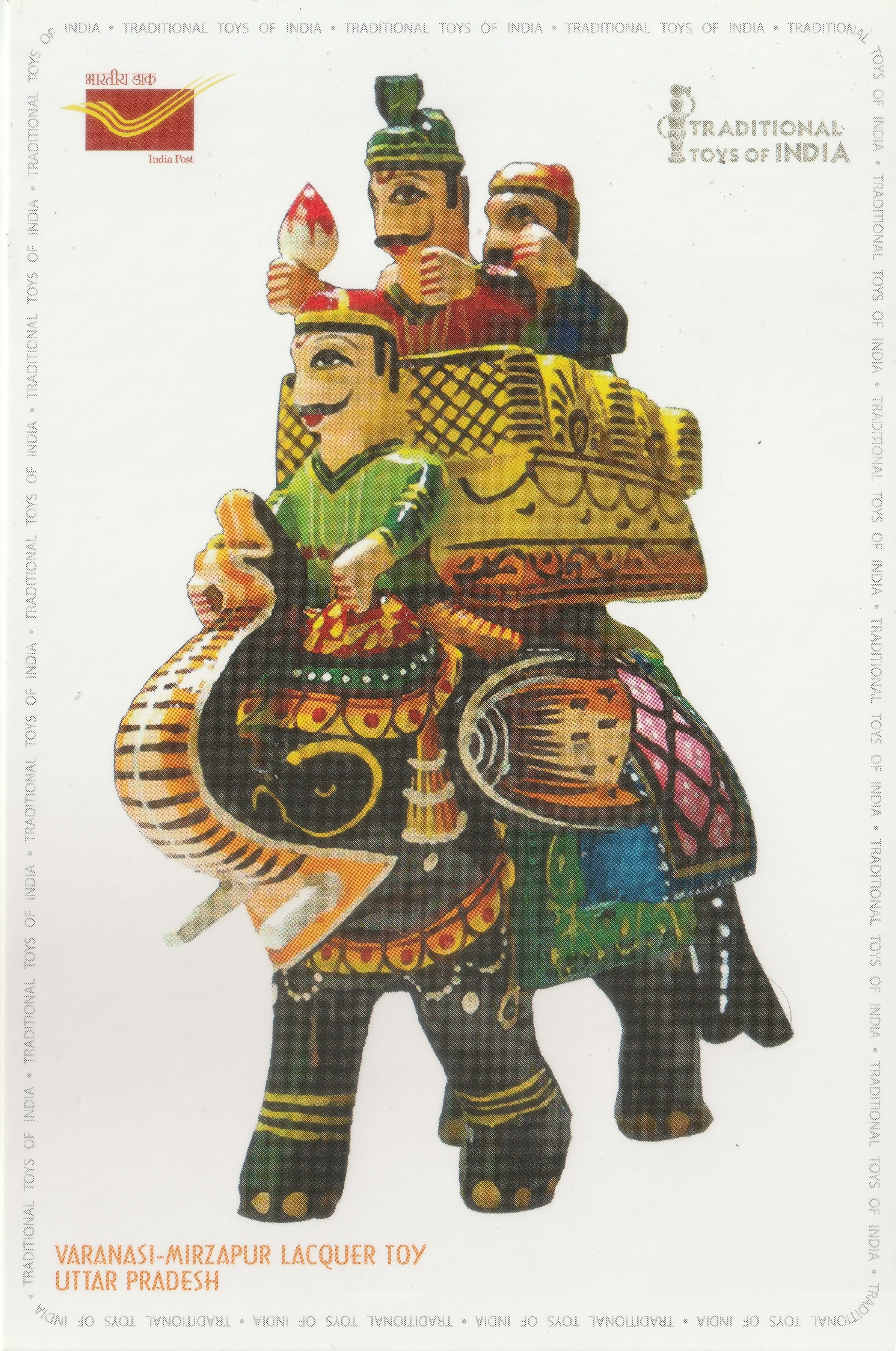
India Post has also issued a Picture Post Card on Varanasi Wooden Lacquerware and Toys, though the cancellation is at Bengaluru Museum Road PO where the Post Cards are issued, it is shown for information purpose.

Picture Post Card Issued on 
Varanasi Wooden Lacquerware & Toys
Front Side Scan

Back Side Scan with cancellation from Museum Road PO

Tuesday, May 21, 2024

184. Banaras Metal Repousse Craft

Banaras Metal Repousse Craft is raising a design in relief on metal from the back or inside using hammers and punches. Details are then generally done on the design from the front, using chasing or repousee. 

The whole technique is sometimes referred to as ‘chasing’, or embossing (Khal – Ubhar KaKam). The art has been preserved in the by lanes of Varanasi for generations by Kasera community. Repoussé is a method used by traditional artists to create distinctive dishes, doors, traditional ornaments, garments, and faces of gods and goddesses using gold and silver.

Repousse is a metal working technique in which a malleable metal is ornamented or shaped by hammering from the reverse side. It is used to work on the reverse of the metal to form a raised design on the front. The techniques of repousse utilize the plasticity of metal, forming shapes by degrees. There is no loss of metal in the process, as it is stretched locally and the surface remains continuous. 

Image Credit: varanasivideos.com

The historic city of Varanasi has been home to the thriving repoussé craft since the Vedic era. It is believed to be even older than the Banarasi Silk handloom industry. The process of metal repousse craft from start to the end is completely handmade using with the traditional tools in a home-based atmosphere, it is a complete home based work where the artisans are working since generation.

First, drawings of both traditional and modern patterns and designs are made by hand on paper. The metal sheet is prepared and cut. The metal sheet is filled with lac and the design is transferred using traditional small tools. The paper design is removed and embossing work begins with the side which has to be depressed beaten down. 

The lac is then heated and melted. The sheet is reversed and sections to be raised in the finished design are beaten outwards. The process is repeated 3 – 4 times so that all the details are incorporated. The product is washed in acid through an old method of cleaning. 

Banaras Metal repousse may be roughly divided into the religious, ritualistic items and objects of utility. The metals used are brass, copper and bell metal. From the limited domestic use it has moved to various directions, especially into the prestigious ritualistic field.

GI Tag Registration Date         : 31 May 2016

GI Tag Number                         : 398

Certificate Number                  : 264

Geographical Area                  : Uttar Pradesh

Special Cover Release Date   : 13 October 2021

Cancellation                             : Varanasi 221 001

Type                                          : GI Tag Cover

Cover Identification Number  : UP/95/2021

Enlarged View of Illustration

Enlarged View of Cancellation

Back Side Scan