Showing posts with label Andhra Pradesh GI. Show all posts

Saturday, August 10, 2024

265. Budithi Bell and Brass Metal Craft

Budithi Bell and Brass Metal Craft are the products made out of alloy like brass at Budithi, a village in Srikakulam district of Andhra Pradesh. Usually made of brass, the objects have patterns that are geometric, with straight lines and curves forming simple and striking presentations. Floral patterns are abound too.

The brass and bell metal activity is nearly 200 years old which is concentrated in three separate revenue villages viz., Avalangi, Bhuditi, and Chidipudi. These villages are referred as 'A B C of Brass Ware' by the locals. In these villages life revolves around creating beautiful shapes out of alloys. The shapes range from charmingly traditional items to elegantly modern ones. 

Image credit: srikakulamads.com

Bindelu vessels are made from brass metal, which is an alloy of copper and zinc. It is a two-piece vessel which is formed by beating two different sheets of brass till the required shape is achieved. Two pieces are welded together and finished from the inside. The mouth of the vessel is made by welding a cast ring on to the finished sphere. Finally outer surface of the vessel is scrapped and polished, which adds a lustre to the piece.

Bell casted from bell metal is used in temples. It is one of the oldest and famous craft of Budithi. This product is normally in high demand throughout the year. It is highly resonant which provides a longer lasting sound than general. This uniqueness comes from the old traditional methods of casting the bell which is being followed till date. Also the process always begins after performing rituals and offering prayers which according to them imparts the distinct sound.

This process of bell making is highly labour intensive process which does not involve much of the utilization of machines and most of work is being done by people by using normal tools and procedures. 

The furnace is used for the purpose of producing the needed fire and heat for melting the brass and bell metal in order to be put into the moulds of the bell. This process involves mixing of soil rich in silicon and jute fibres which is done on the basis of the experience of the craftsman hence neither any machine is useful for this purpose and nor it is economically viable

The art form expresses itself as traditional cooking utensils and also in forms that suit contemporary needs - like flower pots and planters. The artisans mainly work on creating brassware objects such as, bells for temples, cooking utensils, flower pots, lamps etc., which have different geometric patterns as well.

GI Tag Registration Date         : 09 September 2008

GI Tag Number                         : 89

Certificate Number                  : 88

Geographical Area                  : Andhra Pradesh

Special Cover Release Date   : 12 April 2022

Cancellation                             : Budithi 532 247

Type                                          : GI Tag Cover

Cover Identification Number  : AP/17/2022

Enlarged View of Illustration

Enlarged View of Cancellation

Back Side Scan

Friday, August 2, 2024

257. Udayagiri Wooden Cutlery

Udayagiri Wooden Cutlery are wide ranges of wooden products that are being made in Udayagiri, Andhra Pradesh. These are basically cutlery items like spoons, forks, salad bowls and are made with Persian motifs, which bring beauty to the products. The main product range includes wooden cutlery, spoons, forks, salad bowls etc.

Udayagiri Wooden Cutlery is made of wood which are locally available in the forest in & around Udayagiri like Nardi, Devadari, Bikki Chakka, Kaldi Chakka and Palabarki. Out of all, the most commonly used wood is of Naridi; because it is very soft and easy to handle. The smaller spoons or the pallis are made out of nardi and bikki wood. Bigger spoons and forks are made out of harder wood called kaldi. They are used to serve curry and rice. 

Image credit: directcreate.com

The carving is done on the handle; holes are drilled according to the pattern of the design and files are used for finishing. The decoration on the handles is made by drilling holes according to the pattern and finishing with files. Although it would appear to be made using a fret saw, the cut-out patterns are done entirely by drilling and filling.

This craft is said to have originated during the Quli Qutub Shah dynasty, and passed on to generations over time. The artisans are skilled in this particular craft and this art is traditionally and hereditarily transferred from their fore fathers. Earlier men used to work on this craft but now mostly women practice this craft.

The wooden blocks are cut into many blocks of desired sizes. The blocks are now completely wound by the jute threads to remove the moisture and make it dry. This whole process removes the moisture present in the wood and makes the wood dry. This makes the wood soft and enables the wood to be carved into the desired shape. 

Depending on the desired shape, marking is done on the wood and it is cut into the desired size. A basic shape is made by removing the extra bark using chisel. This chiseling is done carefully as the wood is soft. 

Using various tools like Uli (Chisel), Golkadi (pointed file), vanki, dabba, kathi, chani, nail etc, artisans make more details and motifs on the products. They remove the surface layer by layer slowly using these tools. For making holes drilling machine is used. In the final stage of the production, finishing is done through paper finishing machine. Where as finishing for smaller patterns and motifs are done by file.

GI Tag Registration Date         : 27 April 2017

GI Tag Number                         : 522

Certificate Number                  : 288

Geographical Area                  : Andhra Pradesh

Special Cover Release Date   : 16 March 2022

Cancellation                             : Udayagiri 524 226

Type                                          : GI Tag Cover

Cover Identification Number  : AP/15/2022

Enlarged View of Illustration

Enlarged View of Cancellation

Back Side Scan

Saturday, June 15, 2024

209. Bandar Laddu

Bandar Laddu is a very famous and traditional local sweetmeat delicacy of Machilipatnam in Krishna District of Andhra Pradesh. Bandar Laddu is prepared by using Bengal gram flour, jaggery syrup and ghee as its basic ingredients. Bandar Laddu is also known as Machilipatnam Laddu, Thokkudu Laddu, Machilipatnam Bandar Laddu. Machilipatnam is also known as ‘Bandar’ since times immemorial. 

The origins of this sweetmeat of ‘Bandar Laddu’ can be traced from the 'Bondili ' community of Andhra Pradesh who live in good numbers in and around the town of Machilipatnam even today. Bondili people who migrated to Andhra Pradesh many centuries before from 'Bundelkhand’ region of Uttar Pradesh were traditional sweetmeat makers and practiced in traditional medicine.

Image Credit: bandarmithai.in

The following process are followed to prepare Bandar Laddu: Besan flour is mixed with water by hand to ensure that lumps of flour are easily mixed with water to obtain consistent dough. Pure Ghee is poured in a Kadai (Pan) and is heated well. A locally made ladle, which is hand held and perforated, through which dough is extruded. 

The Dough is kept on ladle and pressed hard to ensure that the 'chaklis ' (strands) are obtained and they are allowed to fall on the hot ghee in Kadai and deep fried. The chaklies (strands) upon turning into golden yellow colour are removed from the kadai and the excess ghee is drained and the chaklies (strands) are allowed to cool. 

Upon cooling the chaklies (strands) are hand pounded into coarse powder. In a separate kadai (pan) the jaggery syrup is prepared, by using crushed jaggery lumps and water is added to this mixture and it is heated and syrup is obtained. 

The pounded chaklies is mixed with the hot jaggery syrup and allowed to cool for Five Hours. Periodically this mixture is pounded to ensure the texture of the Bandar laddu is obtained. Upon cooling, the mixture is hand rolled into balls. Sometimes, for enhancement, cashew nuts and raisins are added, cardamom powder is also added to enhance the aroma.

The special characteristic of Bandar Laddu can be attributed to a host of factors like choice of pure ingredients and also, the specialized human skills of meticulous preparation of ‘chaklis’ by carefully extruding them in ladles and frying it in ghee for stipulated time. 

Most importantly the hand pounding of the jaggery syrup and besan flour mixture to achieve a homogeneous material for making the Bandar Laddu has been the art perfected by the skills gained by the local sweet makers of Machilipatnam.

GI Tag Registration Date         : 26 April 2017

GI Tag Number                         : 433

Certificate Number                  : 286

Geographical Area                  : Andhra Pradesh

Special Cover Release Date   : 15 November 2021

Cancellation                             : Machilipatnam 521 001

Type                                          : GI Tag Cover

Cover Identification Number  : AP/41/2021

Enlarged View of Illustration

Enlarged View of Cancellation

Back Side Scan

Monday, April 8, 2024

141. Bobbili Veena

Bobbili Veena is a traditional large plucked string instrument with great importance and significance in the evolution of Carnatic Classical music. It is made up of seasoned Panasa wood (jackfruit) and has vibrant designs and colours in order to give a designer look. The origin of the Bobbili Veena can be traced back to 16th century to the days of the Bobbili Samasthanam. 

Plastic white sheet with inlay works of art is pasted throughout the Veena. This acts as a border to the entire veena, giving an artistic look to the veena. Designs of flowers and leaves are inlayed on the main plastic sheet. 

Image Credit : www.gitagged.com

Bobbili Veena is also known as Saraswathi Veena and the main parts of the Bobbili Veena are

  • Kunda – main base of the veena, it is fixed at the front end of the Dandi
  • Dandi  – the frame that forms the length of the veena (fret board). There are 24 frets and all are made only of bell metal.
  • Thumba – fixed at the end of the dandi which is opposite to the end to which the kunda is fixed (rear bottom end). It is prepared by drying an oval shaped ripe bottle gourd (sorakaya).
  • Yali – fixed at the rear end, which is a scroll that is carved into an elaborate head of a mythical animal. In most of the veenas, the carving on the yali is the figure of a lion.
  • Maruwa  – made out of bell metal and strings run over the maruwa to the bridge and end in the kadiyam.
  • Knobs – used for setting the rhythm and loosening the strings. 
  • Bridge plate – made of rose wood and helps to tie the strings. 
  • Ghanta – in the shape of bell is used to fixing the thumba to the dandi. 
  • Kadiyam – made out of brass is the end point where all seven strings are tied and given the strength 

There four main and three ancillary strings. The first and second string are known as Sajammam and Pachammam and these are made out of Brass. Third and fourth strings are known as Mandaram and Anumandaram and made out of Steel. The side strings are called SA PA SA and also made out of steel with higher thickness. 

The variants of Bobbili Veena are

  • Ekandi – made out of single log wood
  • Kamalam – yali is carved with the figure of the lotus
  • Nemali – yali is carved with the figure of the peacock (mayuri)
  • Swarna Mandal – peacock shaped miniature veenas as decorative art pieces or for the purpose of being given as gifts or mementos. 

GI Tag Registration Date         : 06 January 2012

GI Tag Number                         : 203

Certificate Number                  : 163

Geographical Area                  : Andhra Pradesh

Special Cover Release Date   : 14 September 2021

Cancellation                             : Bobbili Bazar 535 573

Type                                          : GI Tag Cover

Cover Identification Number  : AP/38/2021

Enlarged View of Illustration

Enlarged View of Cancellation

Back side Scan


Friday, April 5, 2024

138. Andhra Pradesh Leather Puppetry

Andhra Pradesh Leather puppetry in general is a shadow play with puppet, the puppets being prepared with Parchment Leather at Nimmalakunta in Anantpur District and Narsaraopet of Guntur District. 

Parchment leather is used to make 

  • Puppets for Tholu Bommalatu (Shadow play) meaning, “The Dance of Leather Puppets” 
  • Puppets for Lamp shades and 
  • Puppets for wall hangings & other utilities.

Parchment leather is prepared from animal skins such as Goat & Sheep skins for small sized puppets and from Cow and buffalo hides for large sized puppets. On the parchment leather grooves and holes are punched with special tools to depict designs of mythological characters. 

In Shadow play, this form of art is popularly known as ‘Tholu Bommalata’ in Telugu is one of the earliest performing arts, dating back to the 3rd century B.C. and reaching its pinnacle during the days of the Vijayanagar Empire. These puppets are folk-lore in style, conception and execution.

Image Source from Internet

Epic themes predominate in designs in Leather puppets. Ramayana theme predominates in the designs with huge puppets of Hanuman, Ravana with ten heads, Vinayaka seated regally, all being depicted in vivid colours. Even on the lampshades, deities hold sway along with animals and floral designs.

Process of production depends on the type of puppets and the purpose for which they are meant. For example, puppet leather for lamp shades should be as white as possible to permit shadow of light. Puppets meant for wall hangings can be coloured lightly.

The Intricate process starts with tanning and processing of the goat skin which is then cut into required shapes and sizes. The intended drawing is outlined on the leather by using a pencil or a charcoal. The Craftsman creates a beautiful pattern of etches along the outlines by using chisels of different shapes and sizes. 

Finally, a skilled artist fills vibrant colours to the artwork and brings the product to life. The colours are filled in with vegetables dyes - brilliant reds, greens, whites, yellows, browns and orange ruling the roost. 

The use of light to depict and narrate epics on screen and puppets modelled representing mythological characters created artistically out of leather have contributed to the uniqueness of these lampshades. 

The lampshade is made to look more attractive by chiseling small holes in a decorative pattern on it. The perforation executed on the coloured leather gives an appearance of rich ornamentation against the background of light.

GI Tag Registration Date         : 09 September 2008

GI Tag Number                         : 107

Certificate Number                  : 93

Geographical Area                  : Andhra Pradesh

Special Cover Release Date   : 08 September 2021

Cancellation                             : Vijayawada HPO 520 001

Type                                          : GI Tag Cover

Cover Identification Number  : AP/37/2021

Enlarged View of Illustration

Enlarged View of Cancellation

Back Side Scan


Wednesday, April 3, 2024

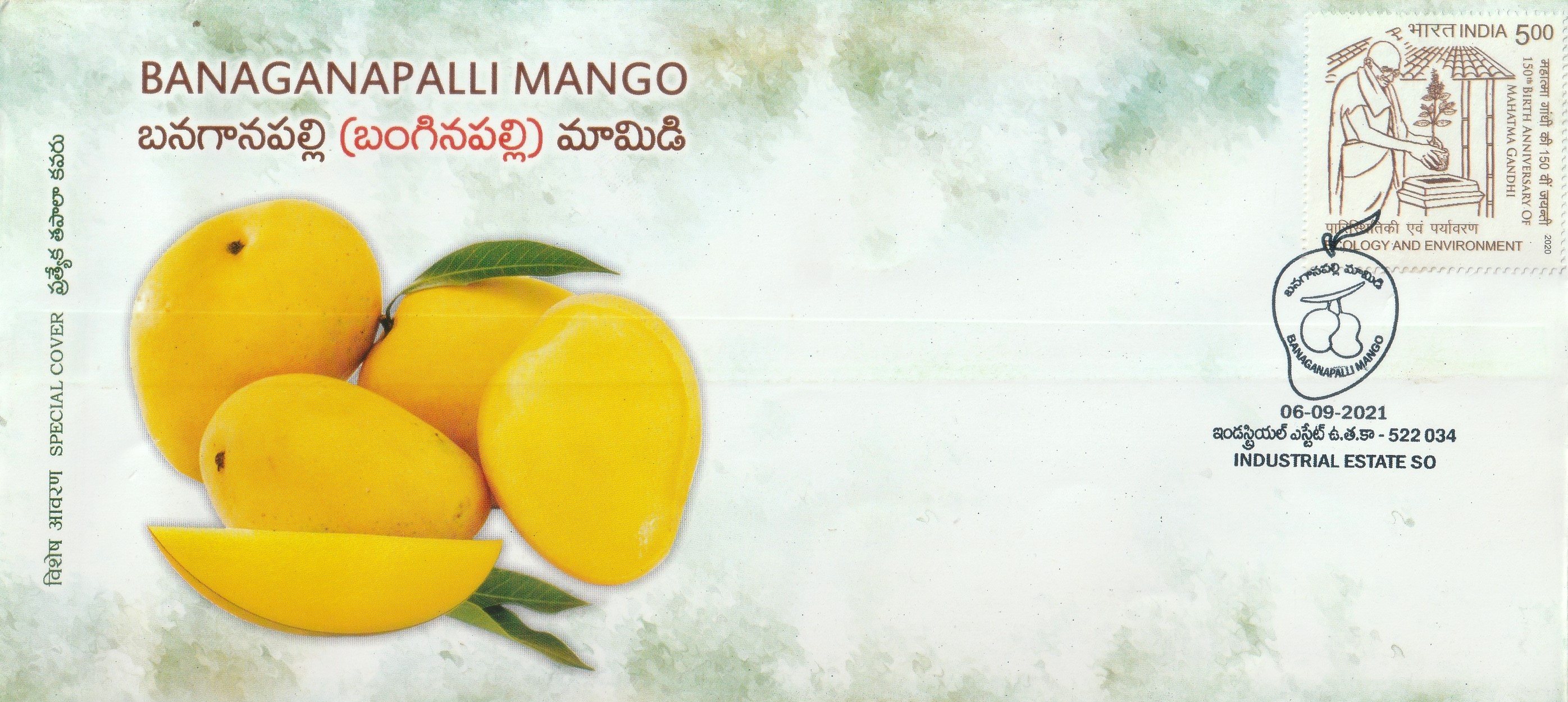
136. Banaganapalle Mangoes

Banaganapalle Mangoes are considered to be one of the finest Desert Mangoes. They exhibit unique characteristics in aroma and appearance that has remained constant for more than 100 years since its first induction by Nawabs of Banganapalli. 

The fruits are native to Banganapalli, Andhra Pradesh and is extensively used as Table Fruit all over the world for its fibreless Sweet meaty pulp. They have gained wide acceptability throughout the globe due to their novel characteristics in aroma, taste, shape & size of the fruit and appearance.

The cultivating regions of ‘Banaganapalle Mangoes’ can be classified into two in the state of Andhra Pradesh and Telangana

Primary Centre of origin called as ‘Banaganapalle region’ of Kurnool district comprising, Banaganapalle, Paanyam and Nandyal mandals.

Secondary Centres of origin comprising of

  • Rayalaseema region – Kadapa, Chittoor,  Anantapur and other parts of Kurnool districts.
  • Coastal Andhra Region - Prakasam, Krishna, East Godavari, West Godavari and Guntur districts.
  • Telangana region - Khammam, Mahabubnagar, Rangareddy, Medak and Adilabad

Banaganapalle mango also known as Beneshan, Baneshan, Benishan, Chappatai, Safeda, Banaganapalli, Banginapalli are very much popular and extensively used table fruit all over the world. 

Banaganapalle Mangoes’ are large in size, oblique to obliquely oval in shape with their ventral shoulders markedly broader and higher than dorsal, ventral shoulder progressively rising and then rounded, dorsal shoulder ending in a long curve. Beak point is missing. 

The stalk is fixed in a basal groove. The skin is thin with very light spots. The colour of the ripened fruits is golden yellow (primuline yellow), the texture of the pulp being pulpy (firm to meaty) and fiberless. The pulp content is 75-80%, stone is 10-15% and the skin is 5%.

GI Tag Registration Date         : 03 May 2017

GI Tag Number                         : 241

Certificate Number                  : 295

Geographical Area                  : Andhra Pradesh, Telangana

Special Cover Release Date   : 06 September 2021

Cancellation                             : Industrial Estate SO 522 034

Type                                          : GI Tag Cover

Cover Identification Number  : AP/36/2021

This cover is issued by Andhra Pradesh Postal Circle.

Enlarged View of Illustration

Enlarged View of Cancellation

Back Side Scan


Monday, January 8, 2024

048. Dharmavaram Handloom Pattu Sarees and Paavadais

Dharmavaram Handloom Silk Sarees and Silk Pavadas are exclusively made of mulberry silk woven by hand. The material is made from 100% pure silk from Mulberry cocoons. These sarees are often used for making classical dance costumes for Bharath Natyam and Kuchipudi dancers.

Dharmavaram Sarees are essentially made with elaborate zari work woven on them in resplendent colours. The characteristic Dharmavaram saree has broad solid colour borders with intricately woven brocaded gold border. Green, silver and pink coloured zari also used.This adds to elegance and grandeur of the textile. The zari for borders is used in warp and for pallu and body zari is used in weft. 

Designs and Motifs represented on pallu and body of saree are symbolic of flora and fauna, are largely inspired by temple murals and paints from Lepakshi temple, near Anantapur. Recently scenes from epics are also largely depicted. Leaf, Flower, Fruit, animals and bird designs are largely incorporated in Dharmavaram sarees. Peacock and Parrot designs are however the most popular and most traditionally used.

Presence of Kuttu, where border is independently created and attached to the body of the saree of pavada using special techniques is a characteristic of Dharamavaram Sarees. However kuttu is not prevalant in pallu. Single side border would have one side kuttu and double side border has two kuttus. Materials can also be made without kuttu.

The semi-arid tropical climate and the quality of water contribute to the colour fast nature of the yarn during production. It is eco-friendly, highly durable and enhances the grandeur and aura of the lady wearing it in social functions. Though worn in all weather conditions, it is better suited for cool or cold climate. It is most appropriate for grand functions.

GI Tag Registration Date         : 31 March 2014

GI Tag Number                         : 215

Certificate Number                  : 207

Geographical Area                  : Andhra Pradesh

Special Cover Release Date   : 07 August 2021

Cancellation                             : Vijayawada 520 001

Type                                          : GI Tag Special Cover

Cover Identification Number  : AP/26/2021

This cover has a small replica of a Dharmavaram Saree affixed on it.

Enlarged View of Illustration

Enlarged View of Cancellation